Phoenix north valley
Pool Draining and Acid Wash
Draining the pool and washing the interior with an acid cleaning solution that lifts hard-water staining, algae and dirt. An economical way to renew a pool every two to four years.
Chapter 01
What hard water does to a pool interior over a few summers
A Phoenix pool is a slow experiment in evaporation. With Arizona's hard water, extreme summer temperatures and high evaporation, the minerals stay behind while the water leaves, and every refill adds more. Once the water is saturated with hard-water minerals, it starts to stain the interior surfaces, and the plaster stops looking like the colour it was when the pool was built.
That is the case an acid wash is made for. The pool is drained and the interior is washed with an acid cleaning solution that removes contaminants, algae and dirt, brightens and sanitizes the surface, and takes off most of the staining. For pools in Anthem, Peoria, Surprise and Scottsdale that have gone dull, it is a great economical solution to renew your pool.
Draining is also the answer to one water chemistry problem. Calcium hardness belongs between 200 and 400 ppm. When it runs higher than that, the fix is to drain the pool halfway and bring it back down with fresh water.
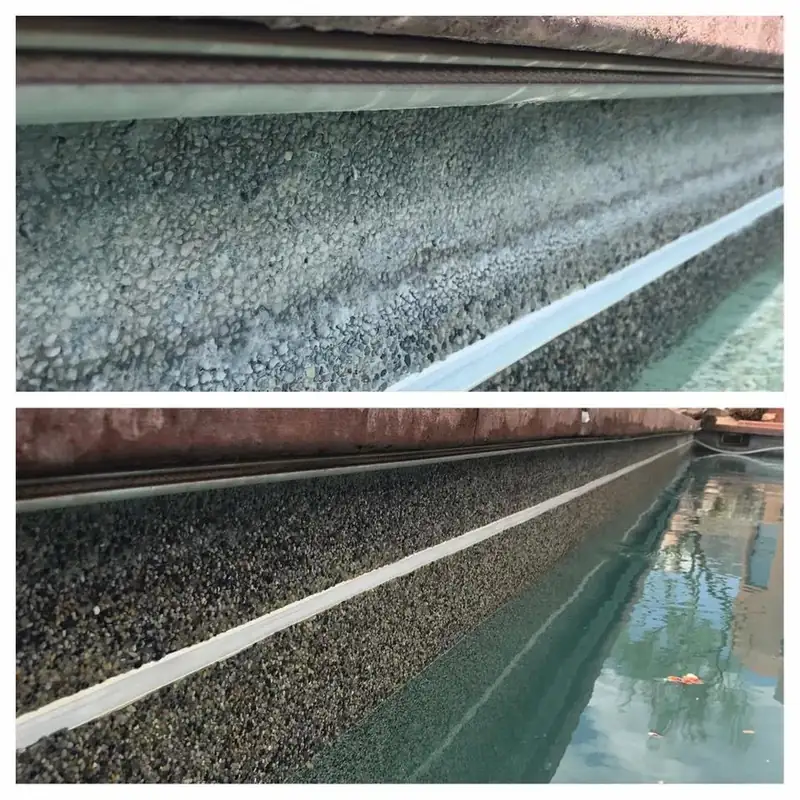
Pebble Tec at the waterline under a travertine coping, shown before and after cleaning
How a drain and acid wash goes, and how it differs from tile cleaning
Tile cleaning never drains the pool. For calcium on the waterline, Andy lowers the water 6 to 8 inches, exposes the band and blasts it off while the rest of the pool stays full. A drain and acid wash is a different job on a different surface: the water comes out, the interior plaster is washed with the acid solution, and the pool is rinsed, refilled and balanced again.
In general, an acid wash is judged by what is left behind when the surface is dry: even colour, no dark patches where algae sat, no rust-coloured or grey staining where minerals dried on. If the waterline tile also carries a white calcium band, that is handled as its own calcium removal job, usually while the water is already down.
Nothing is published as a flat price for draining and acid washing, because the size of the pool and the state of the plaster set the work. The estimate is free and comes over the phone. Call (480) 818-7235, answer a few questions and send some photos.
Chapter 03
How often to do it, and what to watch between washes
In Arizona the usual rhythm is every two to four years. Heat and evaporation set that clock more than any calendar does, so a pool in the hot corners of Desert Hills or New River can reach the point of staining sooner than one that is shaded and topped up often.
Between washes, the water chemistry does most of the protecting. Keep calcium hardness between 200 and 400 ppm and hold the pH steady, because a pH that runs too high for a stretch is also what lays a white line down at the waterline.
The signs it is time to call: mottled or dull plaster that brushing does not touch, green or dark patches that return after treatment, and a pool that looks tired even when the water test reads fine. From Cave Creek, Carefree, Paradise Valley and Phoenix, the first step is the same free call.
Owner-operated by Andy Davidson, an Arizona LLC since 2016. Free estimate by phone: (480) 818-7235.
Two ways to renew a pool
Lower the water 6 to 8 inches, or take it all the way down
- Tile and Pebble Tec calcium
- The pool is not drained. The water drops 6 to 8 inches, the white band is blasted off, and the pool can be used right away.
- Interior staining, algae and dirt
- The pool is drained and the interior is washed with an acid cleaning solution. Every two to four years is the Arizona rhythm, and the estimate is free by phone at (480) 818-7235.